NanoClean PoD™: Composition, Efficacy, and Comparison with IPA in 3D Resin Cleaning
NanoClean PoD™ is the isopropyl alcohol-free 3D printed part cleaning fluid developed by Smart Dent. Its surfactant base is compatible with high inorganic content resins, preserving structural integrity and preventing the "chalk effect" caused by IPA in materials like Smart Print Bio Vitality.
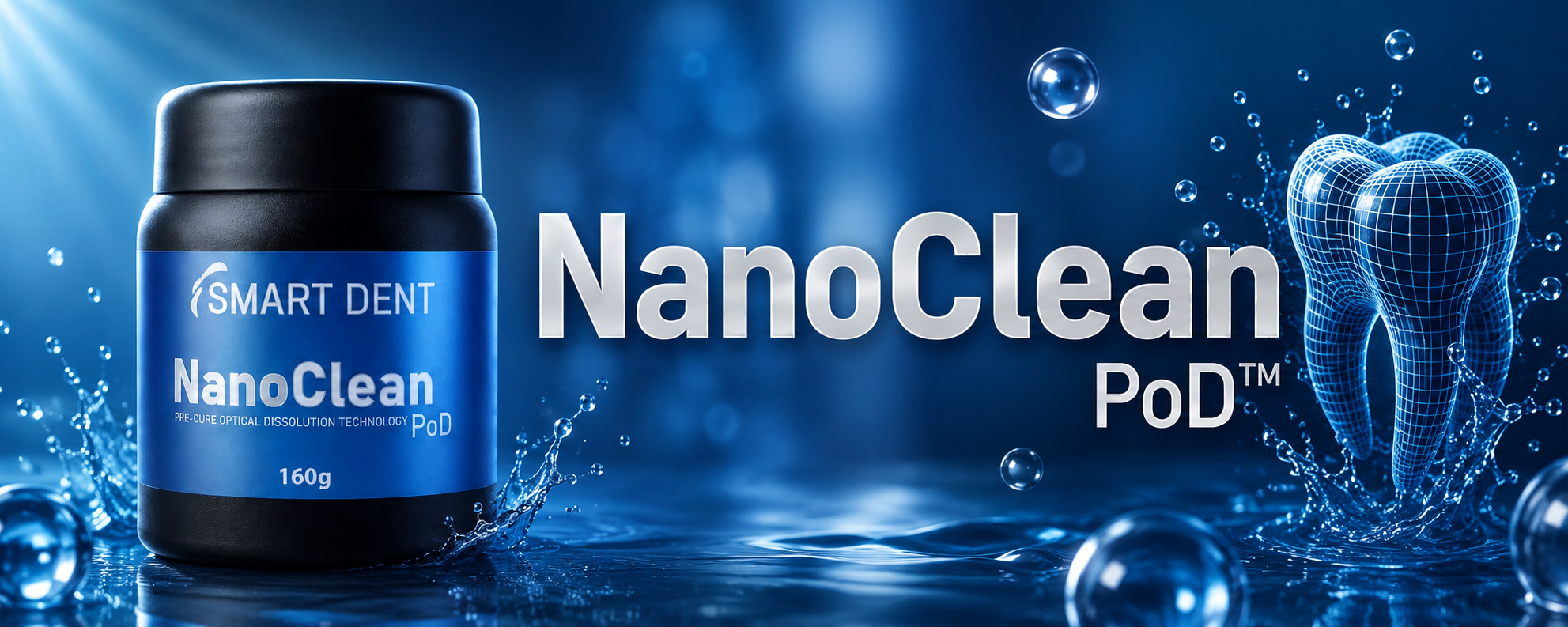
NanoClean PoD™ is the isopropyl alcohol-free 3D printed part cleaning fluid developed by Smart Dent. Its surfactant base is compatible with high inorganic content resins, preserving structural integrity and preventing the "chalk effect" caused by IPA in materials like Smart Print Bio Vitality.
Why IPA Causes Problems in High-Filler Resins
Isopropyl alcohol (IPA) is the most common cleaning fluid in 3D printing due to its cost and availability. However, in resins with high inorganic content — such as Smart Print Bio Vitality with its nanocomposites — IPA presents significant technical limitations:
- Chalk effect: IPA penetrates the resin surface during washing and leaches organic phase components, leaving inorganic nanoparticles exposed. The result is an opaque, whitish surface with an irregular texture before post-curing.
- Reduced surface strength: Leaching of the organic phase in the surface layer can reduce the mechanical strength of the part by up to 8–12% compared to cleaning with a neutral surfactant.
- Interference with cementation: Surfaces with a chalk effect exhibit lower surface energy, which compromises the adhesion of resin cements without additional treatment.
- IPA residue: Traces of alcohol on the surface partially inhibit photopolymerization during post-curing, reducing the final conversion degree.
Pre and Post Processing — Smart Print Bio Vitality
PRE-PROCESSING
- Filter the resin through a 100 µm sieve before each reuse.
- Homogenize the resin for 1 min (spatula or controlled agitation).
- Maintain operating temperature between 25–35 °C.
- Check resin level and vat integrity before each print.
Note: resin outside 25–35 °C alters viscosity, filler dispersion, and dimensional repeatability.
POST-PROCESSING
Washing and cleaning — NanoClean PoD
- Carefully remove all supports to avoid damaging the part.
- Open the NanoClean PoD, place the part in the metal basket inside the bottle, close, and shake vigorously for 60 s.
- Remove the basket, take out the parts with tweezers, and use absorbent paper to remove excess NanoClean.
Drying with compressed air
- Apply compressed air (80 in equipment –100 psi) to the entire part until no excess NanoClean remains, especially in internal and adaptation areas.
- In these areas, a microbrush or Nanoclean Pen can be used.
- Position an absorbent paper behind the part during the air jet to retain excess liquid.
The part must be completely dry before post-curing; residues impair conversion and marginal adaptation.
UV Post-curing
Post-curing is the most important step for the material to achieve maximum performance of its mechanical properties. Under no circumstances should this step be neglected, at the risk of premature failure of the prosthetic part.
Desktop equipment — Elegoo Mercury – 36 W
- Veneers: 16 min.
- Crowns: 20 min.
- Bridges: 20 min.
- Protocols: 30 min.
Desktop equipment — Anycubic Wash & Cure – 25 W
- Veneers: 20 min.
- Crowns: 25 min.
- Bridges: 25 min.
- Protocols: 35 min.
General recommendations: internal temperature 25–35 °C; continuous rotation improves curing uniformity.
Industrial equipment — ShapeCure D – 150 W
- Select - Partners (Smart Dent)
- Select the appropriate preset:
- Vitality Veneers
- Vitality Crown
- Vitality Bridges
- Vitality Protocols
Complementary heat treatment
- Choose one of the options:
- Option A – heated glycerin: 30 s at 130–140 °C.
- Option B – electric oven (dry): 60 s at 140 °C.
- Option C – heat gun: 30 s per side at 110–140 °C.
- Option D – Air Fryer: 60 s at 110–140 °C.
Official source: Smart Print Bio Vitality
| Parameter | NanoClean PoD™ | IPA 99.5% |
|---|---|---|
| Cleaning mechanism | Micellar (surfactant) | Dissolution by affinity |
| Chalk effect | Does not cause | Causes in high-filler resins |
| Impact on organic phase | None | Leaches components |
| Residue on part | Removed by water rinse | Evaporates (but inhibits photopolymerization) |
| Compatibility with Vitality | Validated by manufacturer | Causes surface opacity |
| Disposal | Class I waste (non-flammable) | Flammable waste (Class II) |
| Flammability | Non-flammable | Flash point: 12°C |
Validated Operational Workflow
- Part removal from platform: remove the part normally, maintaining care when handling uncured resin.
- Immersion in NanoClean PoD™ — 60 seconds (single bath): place the part in the immersion basket containing NanoClean PoD™. Use mechanical agitation during immersion to maximize residual resin removal. Complete process in a single 60-second bath.
- PoD Dissolution: during immersion, NanoClean PoD™ removes residual resin from the surface without attacking the polymer matrix, promoting controlled chemical reorganization that preserves optical and mechanical characteristics.
- Post-curing: proceed with ShapeCure D or calibrated equipment according to Smart Dent parameters.
Frequently Asked Questions
How often should NanoClean PoD™ be changed?
Change when the fluid becomes visibly cloudy or yellowish, indicating saturation with residual resin. In moderate clinical use (5–10 parts/day), typically every 2–3 weeks. NanoClean PoD™ works in a single 60-second bath — there is no need to divide it into two containers.
Perguntas Frequentes
How often should NanoClean PoD be changed?
Change when the fluid becomes visibly cloudy or yellowish, indicating saturation with residual resin. In moderate clinical use (5–10 parts/day), typically every 2–3 weeks. NanoClean PoD works in a single 60-second bath — there is no need to divide it into two containers.